What did the two sides argue at the appeals court?
The Justice Department was first to make its case, urging the appeal judges to reinstate the banning order.
Lawyer August Flentje said Congress had authorised the president to control who can enter the country.
When asked to point to evidence that the seven countries affected - Iran, Iraq, Libya, Somalia, Sudan, Syria and Yemen - present a risk to the US, he said a number of Somalis in the US had been connected to the al-Shabab group.
Then a lawyer representing Washington state told the court that halting the executive order had not harmed the US government.
Solicitor General Noah Purcell said the ban had affected thousands of residents of the state, with students delayed as they tried to come to Washington and others prevented from visiting family abroad.
Media captionWhy did an Iraq veteran give a stranger his Purple Heart medal?
A Muslim ban or not
The final minutes of the hearing were spent on whether the travel ban amounted to a shut-out for Muslims, which would be unconstitutional.
A 15-page brief issued by the Justice Department on Monday night argued the executive order was "neutral with respect to religion".
But in court on Tuesday, Mr Purcell cited Mr Trump's campaign statements about a Muslim ban.
He also pointed to statements made by one of the president's advisers, Rudy Giuliani, who said he was asked to come up with a way of making a Muslim ban work legally.
Mr Clifton said the ban only covered seven countries, and they were identified by the Obama administration and Congress as deserving of visa restrictions, based on a terror threat.
He asked: "Do you assert that that decision by the previous administration and congress as religiously motivated?"
No, Mr Purcell answered, but President Trump had called for a complete ban and although this was not a complete ban, it was discriminatory.
Media captionLancaster, Pennsylvania: America's refugee capital
What did the executive order do?
Its main components were:
nationals from Iraq, Syria, Iran, Libya, Somalia, Sudan and Yemen - even those with visas - banned from entering the US;
a temporary ban on all refugee admissions;
the reprioritisation of minority religion (interpreted to mean Christian) refugee claims;
a ban on all Syrian refugees;
a cap on total annual refugee admissions to the US of 50,000.
It came into force on 25 January and caused some confusion at US and foreign airports because people were stopped from boarding planes or prevented from entering the US, and sent home.
There was strong condemnation and it was halted last Friday by a federal judge in Washington state.
As a result, people from the seven countries with valid visas were able to travel to the US again.
Washington state, Minnesota and other states want the appeals court in San Francisco to permit the temporary restraining order to stand as their lawsuit works its way through the courts.
Polls suggest that US public opinion is sharply divided on the issue.
Thousands of supporters filled the streets outside a court in Barcelona on Monday as the former Catalan president Artur Mas went on trial.
Accused of serious civil disobedience over Catalonia's unofficial 2014 independence vote, Mr Mas said he took full responsibility for the "political initiative".
The vote went ahead despite an order from Spain's constitutional court.
Prosecutors are calling for him to be disqualified from office for 10 years.
Mr Mas, his deputy Joana Ortega, and Catalan former education minister Irene Rigau face accusations ranging from disobedience and perverting the course of justice to misuse of public funds.
Media captionCatalan trial: Crowds support Artur Mas in independence vote case
Large crowds appeared outside the court in Barcelona on Monday chanting "you are not alone", "democracy is not a crime" and "independence".
The case is being used by pro-independence supporters to galvanise their campaign. The current Catalonia government has promised to hold a new vote in September.
The 9 November 2014 vote, which was not binding, went ahead despite vehement opposition from the national government, and the poll was outlawed by Spain's constitutional court.
Catalan officials say more than 80% of those who voted backed independence. However, only two million voters out of an estimated 5.4 million who were eligible took part.
Mas's court intervention
Mr Mas left it to his lawyer to answer prosecution questions but at one point during Monday's hearing said there had been no intention to break the law or disobey anyone. Although the format of the vote was changed, he said it had only ever been intended to find out the "scope and opinion of Catalonia's citizens".
He argued that the constitutional court's decision to rule against the vote days beforehand had not made clear what the legal consequences would be. "If it was so evidently a crime, how is possible the constitutional court did nothing to enforce its resolution?" he asked.
Current Catalan President Carles Puigdemont said on the eve of the trial that the countdown had begun for an independent Spanish state in Catalonia.
Like other regions in Spain, Catalonia already has the power to run its educational and healthcare systems, as well as limited freedoms in the area of taxation.
Catalonia is one of Spain's richest and most highly industrialised regions, and also one of the most independent-minded.
With a distinct history stretching back to the early Middle Ages, many Catalans think of themselves as a separate nation from the rest of Spain.
Theo said he was sodomised with a truncheon, as well as racially abused, spat at and beaten around his genitals.
He has undergone emergency surgery for severe anal injuries, and has been declared unfit for work for 60 days. He remains in hospital, where he spoke to his lawyer.
He said the police operation quickly turned violent and he was set upon by four officers. He struggled to make sure he was in the view of CCTV cameras, and asked the officers why they were doing this to him.
He said one officer proceeded to pull his trousers down and rape him with a truncheon.
"I fell on to my stomach, I had no strength left," he said.
He was then sprayed with tear gas around the head and in the mouth and hit over the head, he said.
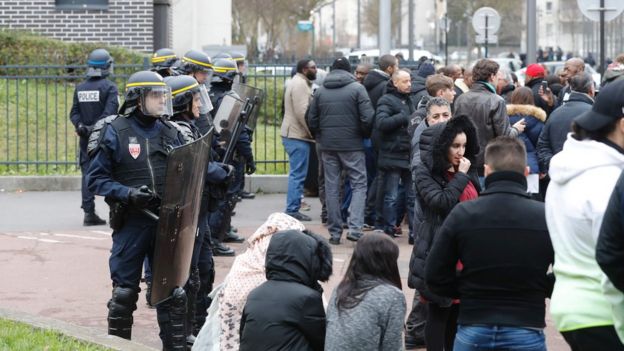
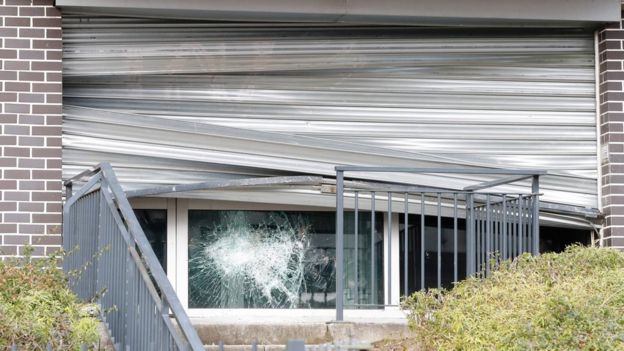
Image copyrightAFPImage captionAs protesters gathered on Monday, riot police stood guardImage copyrightAFPImage captionProtesters burned cars and smashed the windows of this local police station
Theo was then taken to a police station where he said a "much friendlier" police officer saw his condition and sent him to hospital.
Interior Minister Bruno Le Roux suspended the officers and said the facts of the case must be established with "no ambiguity".
A lawyer for the officer facing the rape charge said any injury inflicted during the operation was accidental and his client had "never wished at any time to cause any injury to the victim".
A police union chief, Yves Lefebvre, told AP the rape charge was lodged "to calm or to stop a violent outburst".
'Feeling of humiliation'
Unrest was reported in the neighbourhood over the weekend and continued on Monday evening. Reports said a dozen cars were set on fire, rubbish bins burned and arson attempts made on two restaurants. Twenty-four arrests were made.
"The feeling of humiliation is felt by people," Abdallah Benjana, a former deputy mayor who lives in the neighbourhood, told Associated Press news agency.
"What are [the police officers] seeking? To provoke a spark? Isn't there enough gunpowder in those neighbourhoods?
"Unemployment, insecurity, high rents... no perspectives for future. They do that to a young man, it can only explode."
The tensions have revived memories of the 2005 riots around the French capital, when Aulnay-sous-Bois was one of the worst-affected areas.
Most of us have been caught out by the weather, whether we got soaked to the skin in a storm or burned red by the sun. But there are places in the world where Mother Nature really goes in for the kill. From deadly storms to volcanic eruptions, there are threats everywhere.
Of all Earth's danger zones, which is the most deadly?
Let's break it down into the four elements to find the deadliest places on Earth.
A tidal whirlpool in the Saltstraumen, Norway (Credit: Cephas Picture Library/Alamy)
Most tsunamis – 71% according to the US National Weather Service – occur in the Pacific Ocean
Some waters are more dangerous than others, thanks to unique geographical features that boost their power. The Saltstraumen strait in Norway has earned a fearsome reputation for having the strongest currents on Earth. But the home of the world's most powerful whirlpool has now been so thoroughly studied, tourists can traverse it in an inflatable boat with a knowledgeable skipper.
It is perhaps on dry land then that water is a greater force to be reckoned with. For those living by the coast, inundation by sea water is a particular danger. The Maldives, a group of low-lying islands and atolls in the Indian Ocean, have also been called "the ephemeral isles" because they are so vulnerable to rising sea levels. The risk rises every year as our climate continues to change.
The hazard peaks when water levels rise suddenly, during a tsunami or storm surge.
The 2004 Indian Ocean tsunami was devastating (Credit: Mark Pearson/Alamy)
The summer flood on China's Yangtze River in 1931 is thought to have killed millions of people
There are global tsunami warning and mitigation systems in place to protect people from these life-threatening events. But in some places, the warning times are as short as 20 minutes, so tsunamis can still claim many lives.
In 2004, the deadliest tsunami in recent history claimed up to 280,000 lives across 15 countries, after an earthquake struck off the coast of Sumatra, Indonesia. That death toll is so high, it is hard to comprehend. Yet even more lives have been lost to flooding rivers.
The summer flood on China's Yangtze River in 1931 is thought to have killed millions of people, though official records downplay the casualties. Heavy snowfall that year was followed by thawing and abnormally heavy rainfall, resulting in arguably the worst natural disaster on record.
Today, billions of people still live on flood plains next to China's biggest rivers and flooding is a growing concern as our weather patterns change.
Lake Nyos in Cameroon holds dangerous amounts of carbon dioxide (Credit: jbdodane/Alamy)
Air
A number of "killer lakes" have been found in Africa, but it is not the water that is the worry.
Lake Nyos in Cameroon and Lake Kivu, on the border of the Democratic Republic of Congo and Rwanda, both harbour an invisible danger. These lakes sit on areas of volcanic activity where carbon dioxide leaks from beneath the ground.
Cape Denison in Antarctica is, on a year-round average, the windiest place on Earth
During a "limnic eruption", the carbon dioxide bursts out from the bottom of the lake to form a cloud. Because the gas is heavier than air, it descends, pushing oxygen away and suffocating any life in the area. After twoeruptions in the 1980s killed over 1,700 people and 3,500 livestock in Cameroon, experts devised methods to safely and regularly de-gas the lakes, using pipes and siphons.
But it is not just gases that can kill. The air itself can dish out deadly punishment when winds become brutal.
Haiti is extremely vulnerable to hurricanes (Credit: SPACE BY NASA/Alamy)
Cape Denison in Antarctica is, on a year-round average, the windiest place on Earth. Unsurprisingly, it is uninhabited. However, seasonal storms cause devastation in populated areas worldwide.
The most intense storms are not necessarily the deadliest
The strongest storms form over warm oceans north and south of the equator. Here, the trade winds are boosted by the change in pressure and spun by the Coriolis effect, creating rotating weather systems known variously as hurricanes, cyclones and typhoons.
When it comes to such storms, Haiti is considered the most vulnerable island in the Caribbean. Not only does it lie in a hurricane highway, but the poverty-stricken country lacks resilience. Settlements are built on floodplains, natural defences like forests have been degraded, and the economy is not stable enough to fund flood defences or warning systems.
This explains why the most intense storms are not necessarily the deadliest.
The aftermath of the 1906 San Francisco earthquake (Credit: Glasshouse Images/Alamy)
Jörn Birkmann is an expert in the risks of natural disasters at the University of Stuttgart, Germany. He says that cyclones are dangerous because they are hard to predict.
The worst loss of life due to a cyclone happened in November 1970
"It is important to mention that most likely cyclone tracks will change their spatial pattern," he says. "That means cyclones will occur in some regions which have not seen cyclones before or only very few. These regions are highly at risk, since people and communities have no or very [little] knowledge on how to prepare for cyclones."
Birkmann is part of the team that compiles the annual World Risk Report published by the United Nations University. It highlights the countries that are most vulnerable to natural disasters, considering both their exposure and resilience, with the intention of focussing global efforts to protect them.
In 2016, Vanuatu topped the list. More than a third of the island nation's population are affected by natural disasters each year. In 2015 an earthquake, volcanic eruption and severe Cyclone Pam all hit within just a few weeks and 11 people were officially reported dead.
This relatively low death toll is testament to global efforts to protect people from natural disasters: both during, with improved infrastructure, and after, with better aid efforts. For comparison, the worst loss of life due to a cyclonehappened in November 1970, when Bangladesh was hit by the Bhola cyclone. As many as 500,000 people died.
Part of the San Andreas Fault in California (Credit: Nik Wheeler/Alamy)
Earth
If there is one thing that ties the world's deadliest destinations together, it is tectonic activity.
The Earth's crust is made up of moving plates, and where they move against each other, potential energy builds. When this energy is released, the ground cracks and a seismic wave is thrown out, shaking the surface of the Earth in violent quakes.
Eight of the world's ten most vulnerable cities to natural disaster are in the Philippines
The deadliest earthquake on record was the 1556 Shaanxi earthquakein China, with an estimated death toll of over 800,000. Since earthquakes also trigger tsunamis, it is fair to say they give floods fierce competition for the world's deadliest natural disasters.
The San Andreas Fault, where the Pacific Plate slips alongside the North American Plate, runs through California and is one of the most famous plate boundaries. Since it is so close to home, it is no surprise that Hollywood produced an action blockbuster by the same name. A large earthquake here would cause significant damage.
But again, it is the less affluent parts of the world that are the most vulnerable to earthquake damage. Quake-prone cities like Los Angeles and Tokyo employ the latest architectural advances to make their buildings quake-resistant and protect their residents. But not all the countries along the "Pacific ring of fire" – where 81% of the world's largest earthquakes occur – can do so.
According to the 2015 Natural Hazards Risk Atlas compiled by risk analysts Verisk Maplecroft, eight of the world's ten most vulnerable cities to natural disaster are in the Philippines – which lies not only on the ring of fire but within a typhoon belt.
The harsh landscape of the Danakil Depression (Credit: AGF Srl/Alamy)
Fire
On the flip side of the tectonic coin is volcanic activity. Where plates move away from each other, hot magma from the beneath the Earth's surface spews up to fill the gap.
More than 200,000 people have died as a direct result of volcanoes in the last 400 years
Often described as "the cruellest place on Earth", the Danakil Depression in Ethiopia is the meeting point of three plates. It has possibly the most volcanic activity in the world.
The average annual temperature here is reportedly 34.4C, making it one of the hottest places on Earth. With low rainfall and a landscape dotted by volcanic ruptures, hydrothermal fields and salt pans, you would be forgiven for thinking nobody could survive here. But the Afar people call this place home.
In fact, humans have a habit of settling near unsettling geographic features, and that includes exploding mountains that spew out rivers of fire. The most famous example is Pompeii, the ancient Italian city buried by lava from the eruption of Mount Vesuvius. But several modern cities have views of active volcanoes. Naples is less than 6 miles from Mount Vesuvius, and Mexico City is 43 miles from Popocatépetl.
According to research published by the Global Volcano Model network in 2015, more than 200,000 people have died as a direct result of volcanoes in the last 400 years. The international team of experts also listed the places most at risk of volcanic activity. Indonesia was at the top.
Indonesia's Mount Merapi erupted violently in 2010 (Credit: Reuters/Alamy)
Mount Tambora on the island of Sumbawa directly killed 70,000 people in 1815, leading to a "year without summer" across the northern hemisphere. The eruption temporarily altered the climate, meaning the volcano ultimately claimed even more victims through famine and disease.
Naples is less than 6 miles from Mount Vesuvius, and Mexico City is 43 miles from Popocatépetl
More recently, Mount Merapi caused devastation in 2010, killing over 350 people with its explosions and suffocating ash clouds. Yet tens of thousands of lives were saved by timely evacuations.
It may not be molten lava so much as heat that represents a significant threat in the future. Across Europe in 2003, there were 70,000 deaths as a result of heat stress when a heatwave struck and temperatures soared. Urban areas are particularly at risk, so as our cities grow, heat waves could become natural nemeses for a greater proportion of humanity than ever before.
Experts in disaster mitigation will do their best to keep us safe. But it could be our own success, in procreation and economic development, that causes us the most problems.
Join over six million BBC Earth fans by liking us on Facebook, or follow us on Twitter and Instagram.
If you liked this story, sign up for the weekly bbc.com features newsletter called "If You Only Read 6 Things This Week". A handpicked selection of stories from BBC Future, Earth, Culture, Capital, Travel and Autos, delivered to your inbox every Friday.